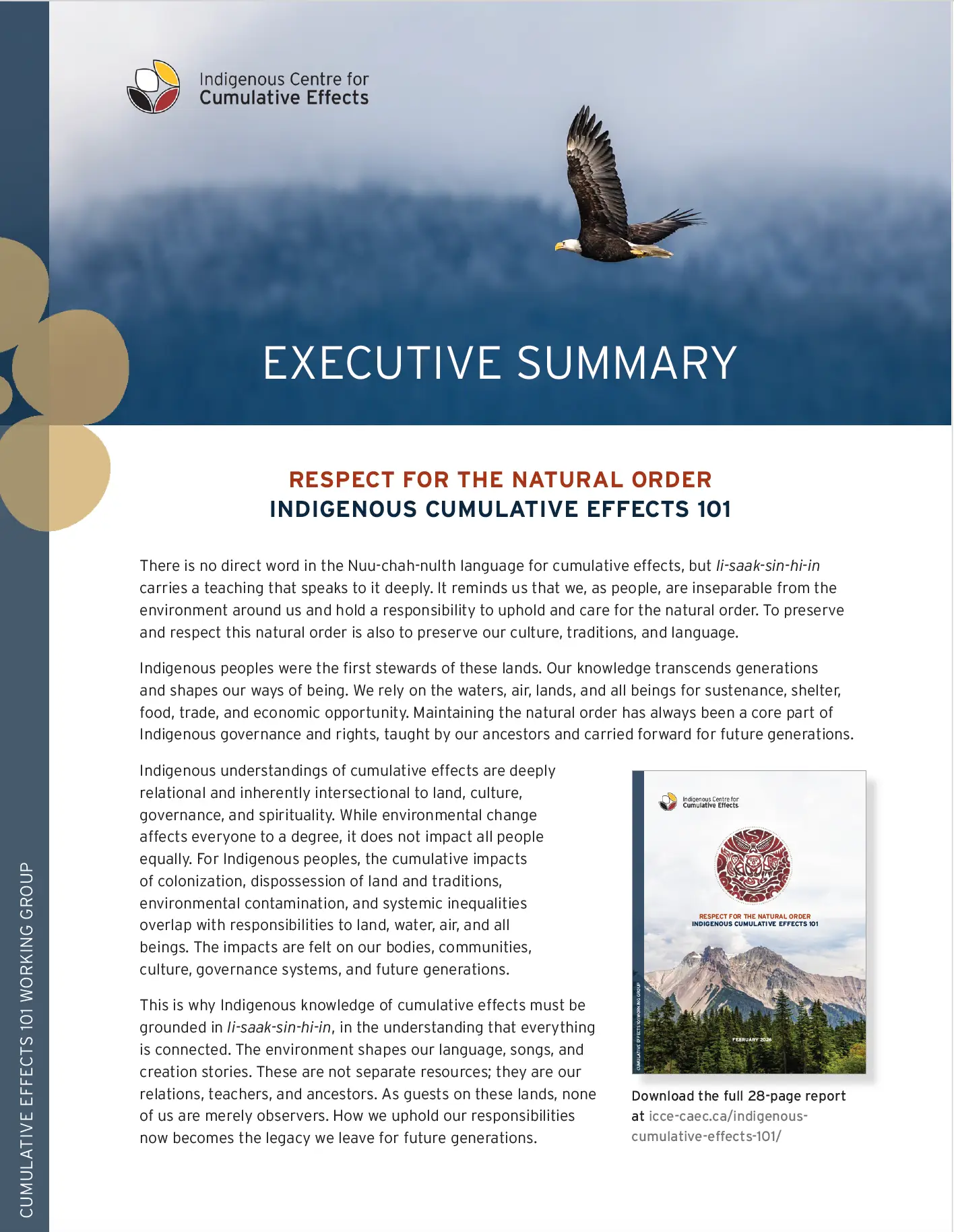

Ce101 Executive Summary cover

Publications and Resources


Executive Summary
Respect for the Natural Order
Indigenous Cumulative Effects 101

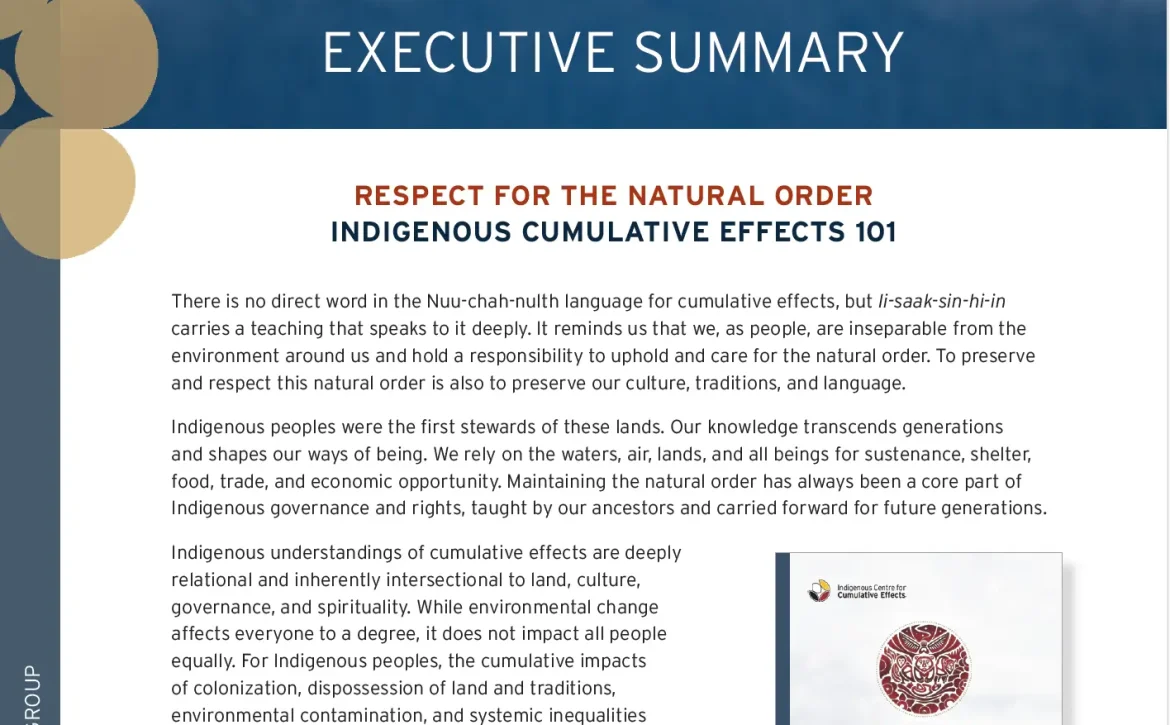
The Indigenous Centre for Cumulative Effects is pleased to launch a preliminary Cumulative Effects 101 resource, co-developed with ICCE staff and the ICCE Technical Advisory Committee. This is the pre-curser to further CE 101 resources and grounds the programming by setting the stage, showcasing the importance of Indigenous law and Indigenous self-determination, while cross-referencing cumulative effects definitions in the First Nations and public sphere. Success stories further capture cumulative effects work taking place across Canada. 

Respect for the Natural Order
Indigenous Cumulative Effects 101

Respect de L'ordre Naturel 
Initiation aux Effets Cumulatifs dans 
Les CommunautÃĐs Autochtones

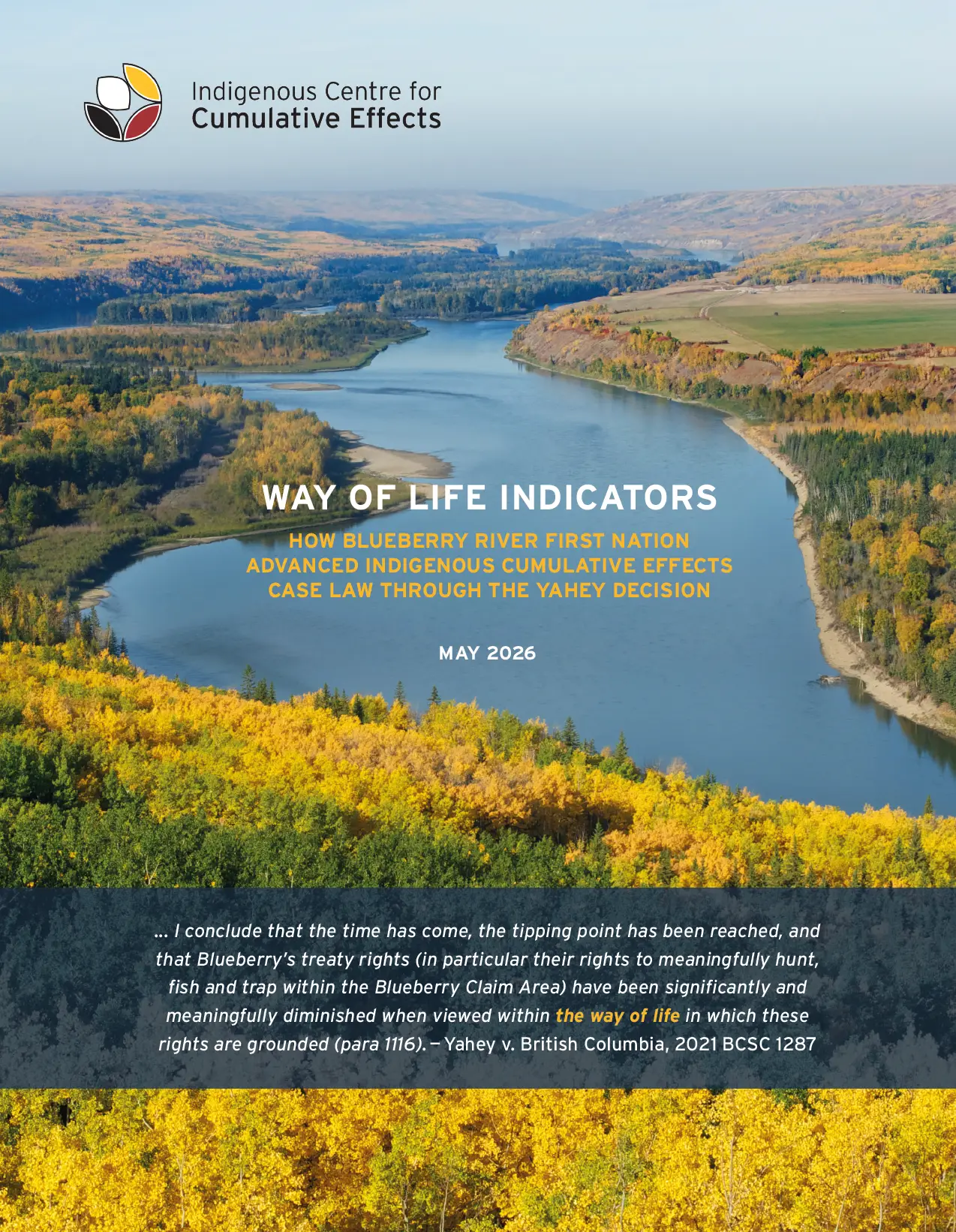
Way of Life Indicators - How Blueberry River First Nation Advance Cumulative Effects Case Law through the Yahey Decision

ICCE has built out a community facing piece on the Yahey cumulative effects court decision, outlining highlights of the evidence used in the groundbreaking Blueberry River First Nation Cumulative Effects court case. While Justice Burke’s decision was released five years ago now, the way of life indicators that informed the decision remain of great significance to cumulative effects and Indigenous rights today. 

Read More
Webcast Post – Canadian Space Agency Training and EO Data Access-2

Webinar: Sharing Earth Observation Satellite Technology & Indigenous Mapping Knowledge


The Indigenous Centre for Cumulative Effects is pleased to host a webinar with the Canadian Space Agency focusing on Sharing Earth Observation Satellite Technology and Indigenous Mapping Knowledge. During this session, participants will explore Earth Observation from multiple perspectives. Guest presenters will highlight the vision and traditional knowledge of First Nations alongside satellite-based Earth Observation, illustrating how the two can complement each other. Also included is a short workshop on available open and free data, how to access it, and how to process it using different platforms. Finally, the presentation will include ongoing activities and welcome participants’ feedback on their various needs and priorities. 

Guest Speakers

    • Dalia Laoubi, Canadian Space Agency
    • Dirk Werl, Canadian Space Agency
    • Siksik Sammurtok-Lavallee 

Read More
Ce101 Executive Summary cover

IAIA26 Conference Connections (Quebec City)

The Indigenous Centre for Cumulative Effects (ICCE) is thrilled to share resources with attendees of the International Association of Impact Assessment (IAIA) 2026 meeting in Quebec City, in support of First Nations, Inuit and Metis led cumulative effects work. 

Resources

The Indigenous Centre for Cumulative Effects is pleased to launch a preliminary Cumulative Effects 101 resource, co-developed with ICCE staff and the ICCE Technical Advisory Committee. This is the pre-curser to further CE 101 resources and grounds the programming by setting the stage, showcasing the importance of Indigenous law and Indigenous self-determination, while cross-referencing cumulative effects definitions in the First Nations and public sphere. Success stories further capture cumulative effects work taking place across Canada. 

ICCE has built out a community facing piece on the Yahey cumulative effects court decision, outlining highlights of the evidence used in the groundbreaking Blueberry River First Nation Cumulative Effects court case. While Justice Burke’s decision was released five years ago now, the way of life indicators that informed the decision remain of great significance to cumulative effects and Indigenous rights today. 

Practitioner Database

  • Many communities and First Nations struggle with where to start in cumulative effects research. To help mobilize first steps and assist communities that seek subject matter expertise, ICCE has updated a database of practitioners who work in the field of cumulative effects. Search by map across Canada or by area of subject matter: 

    Visit Practitioner Database here

Upcoming Opportunities

Join the ICCE Board of Directors, Northern Region
  • The Indigenous Centre for Cumulative Effects (ICCE) is seeking an Inuk (Inuit) Board Member from Inuit Nunangat or Northern Canada to help guide and strengthen our Indigenous-led organization serving First Nations, Inuit, and MÃĐtis communities across Canada.

    For more information or to apply please see the full job description

  • Application Deadline: June 1, 2026
Program Expansion to ICCE Youth Council
  • This year the ICCE Youth programming is evolving to a Youth Council.  We’re creating a space where youth can connect with each other, build impactful relationships, and lead important conversations about cumulative effects. We’re looking for five First Nations, Inuit and/or MÃĐtis youth ambassadors to help lead this network and make it happen.

    To learn more, Click here

  • Stay tuned for an upcoming Live Session. 

Contact Us

Danielle Wilson
Executive Director
danielle.wilson@icce-caec.ca
+1 778-402-3926

Dawn Hoogeveen
Director of Cumulative Effects
dawn.hoogeveen@icce-caec.ca
+1 778 716 8115

Christine Hutchinson
Indigenous Cumulative Effects Advisor
christine.hutchinson@icce-caec.ca
+1 587 801 3115

Leah Harrison
Marketing & Communications Manager
leah.harrison@icce-caec.ca
+1 647 875 2226

Read More
Copy of Welcome to The Team! (1080 x 900 px)

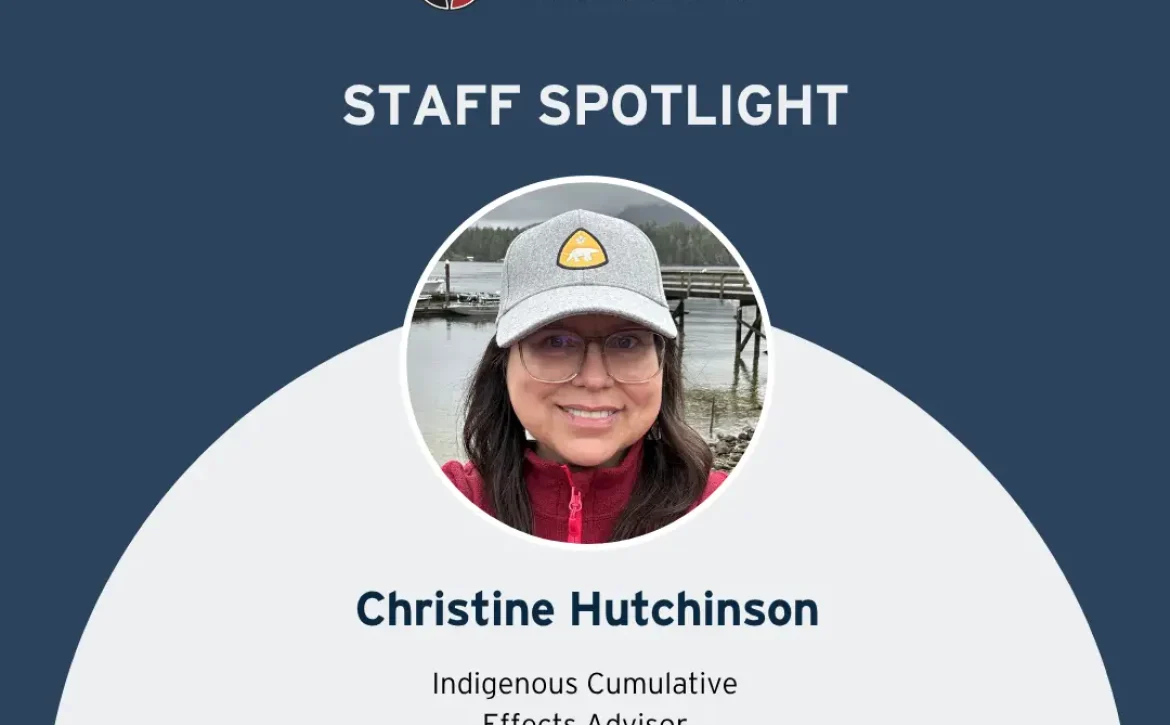
Staff Spotlight – Christine Hutchinson

Six months ago, Christine Hutchinson joined the Indigenous Centre for Cumulative Effects (ICCE) in the new role of Indigenous Cumulative Effects Advisor.  

Christine is a member of Lac La Ronge Indian Band in north central Saskatchewan. A lawyer for 24 years, she has worked primarily with First Nations and for Indigenous-owned organizations. Prior to joining ICCE, Christine was legal counsel at the Canada Energy Regulator, where she advised on regulatory and administrative law matters. A highlight of that work was supporting the CER advance Canada’s reconciliation commitments and implementing UNDRIP.

Since joining ICCE, Christine has supported the launch of ICCE’s new CIRCLE program, Community-led Cumulative Effects Initiatives for Resilience, Culture, Land and Environment. Through the program, 11 Indigenous communities and organizations received grants to build capacity for community based cumulative effects assessment, monitoring, and management last year. Each of the communities advanced work and research grounded in Indigenous values and knowledge systems, while embracing modern data technologies to record and communicate this work.

To date, Christine has also contributed to Cumulative Effects 101, a primer written in collaboration with ICCE staff and the Technical Advisory Committee’s CE 101 working group, soon be released that will provide tools and resources to communities building capacity to undertake cumulative effects initiatives in their territories. CE 101 is centers Indigenous-led frameworks including cultural rights, natural laws, and relationality.

Congratulations to Christine, on her six-month anniversary at ICCE! We look forward to her continued collaborations and bringing her innovative and grounded contributions from her lived experience and her legal background to ICCE. 

Catch Christine, when she speaks on May 7th at a collaborative webinar with RAVEN entitled Cumulative Impacts: Defend the Treaties with Beaver Lake Cree Nation.

Read More
SIKU

Webinar: SIKU Indigenous Knowledge App

The Indigenous Centre for Cumulative Effects is pleased to host a webinar with Candice Sudlovenick of Arctic Eider Society on SIKU The Indigenous Knowledge App.

SIKU is a mobile and web platform created by and for harvesters with more than 40,000 users in more than 150 Indigenous communities from Inuit Nunaat (Greenland to Alaska), and an increasing number of Indigenous communities in southern Canada.

SIKU is a set of tools and services for Indigenous harvesters and land users for travel safety and environmental monitoring that are designed to support Indigenous self-determination and Indigenous Knowledge mobilization through the use of language and terminology systems.

SIKU supports language and education by featuring wildlife and ice descriptions and terminology in the users’ regional Indigenous dialect, supporting education and fluency. With over 100,000 posts made by 15+ Indigenous dialect regions, SIKU has become a leading space for Indigenous knowledge, sharing stories and Indigenous language use in Canada.

Guest Speakers

    • Siksik Sammurtok-Lavallee 
    • Dirk Werle, CSA
    • Dalia Laoubi, CSA

Read More
judy-from-grassy-narrows

Mercury poisoning and the cumulative effects of pollution: Knowledge exchange delves into land stewardship and industrial impacts

By Nora O’Malley, Local Journalism Initiative Reporter / February 13, 2026
The full contents of this article can also be found here at hashilthsa.com

Tofino, BC

Judy Da Silva’s eyes light up as she forks a piece of wild smoked salmon into her mouth.

“It’s like a privilege to me. To me, it’s like gold. It’s good medicine for our spirits when we have our traditional foods,” said Da Silva at the Tin Wis Resort on Feb. 11.

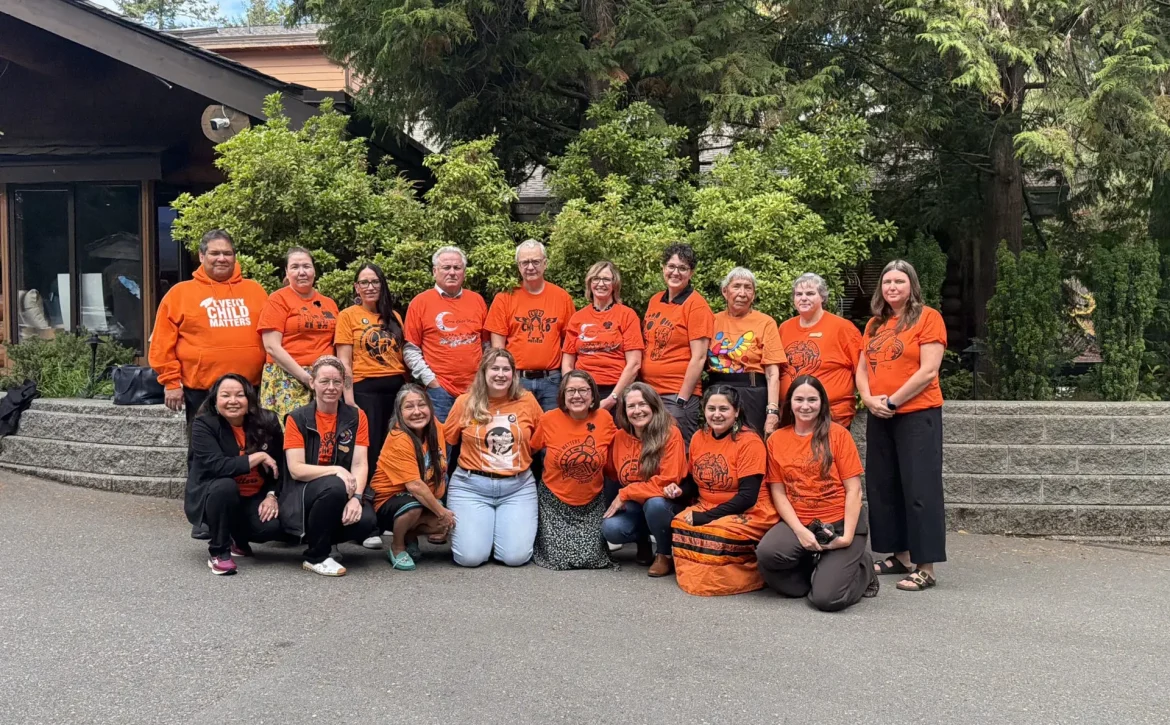
A Grassy Narrows First Nation elder, Da Silva travelled from northwestern Ontario to Tla-o-qui-aht First Nations territory on the west coast of B.C. to share her knowledge with Indigenous representatives from across Canada during an inaugural multi-day gathering hosted by the National Indigenous Centre for Cumulative Effects (NICCE) with support from Tla-o-qui-aht.

Da Silva has spent her whole life suffering from the effects of mercury poisoning.

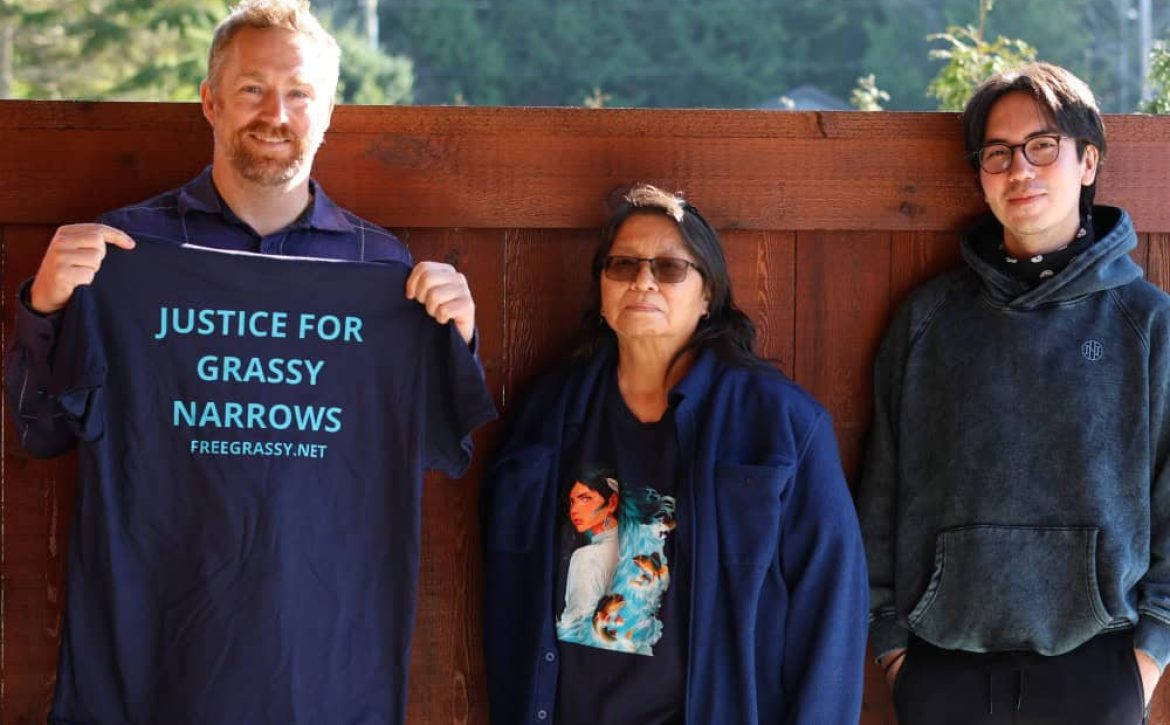
Grassy Narrows First Nation elder Judy Da Silva, centre, travelled to Tofino with advocate Dan Mossip-Balkwill and her son Tedje.
Photo by Nora O’Malley

Between 1962 and 1970, the Dryden Chemical Company’s pulp and paper mill discharged roughly 10 tonnes of mercury into the English-Wabigoon River system, which flows into Grassy Narrows, or Asubpeeschoseewagong Netum Anishinabek territorial waters. Research shows the water system is still polluted to this day.

Before the discharge of the mercury, Grassy Narrows was an active commercial and subsistence fishery. After the mercury was discovered, the Ontario government shut down the commercial fishery; unemployment rates in Grassy Narrows went from five to 95 per cent, according to a community advocacy site. Some members continued to fish for subsistence.

“We get poisoned by eating the fish. Mainstream society will say, ‘Why do you eat poisoned fish?’ It’s our traditional foods. It’s what we learned as a people,” said Da Silva.

Today, Da Silva says almost 90 per cent of the 800 members that reside in Grassy Narrows suffer from mercury poisoning symptoms.

“Mercury is a neurological toxin. It attacks the stem of the brain and it slowly eats away at the brain as you age,” she said. “There are all these hidden truths we never would have found without our advocates out there.”

In collaboration with the Tla-o-qui-aht Guardians program, NICCE gathered representatives from TÅ‚ÄąĖĻchoĖĻ Government in the Northwest Territories, Athabasca Chipewyan First Nation in northern Alberta, Tŝilhqot’in National Government near Williams Lake, B.C., Wabun Tribal Council, Denesuline and York Factory First Nations, Arctic Eider Society and Grassy Narrows for the inaugural knowledge exchange.

One of the main goals for the gathering was to establish an Indigenous network of people working in the cumulative effects realm, says NICCE executive director and Tla-o-qui-aht member Danielle Wilson.

“Cumulative effects are unique to each community, but it’s ultimately that seven generations thinking. What are the means that we need to preserve to make sure that our future generations live and thrive in the same conditions that their ancestors did?” she said.

Tla-o-qui-aht siblings Danielle Wilson and Saya Masso.
Photo by Nora O’Malley

“I hope there are connections made and that communities can lean on one another for support and guidance,” Wilson continued.

Saya Masso, Tla-o-qui-aht’s natural resources manager, said the networking opportunity has been “amazing”.

“I’ve been enthralled to learn about what’s going on up North,” said Masso.

While the North is struggling with declining Caribou herds, Masso said the West Coast is faced with the cumulative effects of over fishing, plastic pollution, forestry impacts and even tourism.

“It’s so important to try and understand impacts so that they can be managed better. Everyone should have the environment in mind and try and have the best plan to mitigate and manage for abundance regardless of what the industry or infrastructure is. It should always be done better,” said Masso.

A highlight of the NICCE gathering was the inclusion of the land-based learning cohort from Ucluelet Secondary School on Feb. 11.

“I was really excited with how much they were engaged,” said Sheena Charleson, an Indigenous support worker from the school. “I was overwhelmed with pride that they were so involved and willing to participate, and also just how powerful their voices are.”

Training more guardians to take care of the land and bringing more youth on the field was noted as a high-priority during the knowledge exchange.

“The more immersed people can be in experiences and time on the land, the more they will be able to see the effects of what is happening,” said teacher Arran Jackson.

“You can’t want to save things you haven’t experienced or care about. You have to have that connection in order to draw a desire to care,” he said.

Da Silva offered some advice to the youth:

“Don’t take mainstream society’s answers as the golden truth,” she said. “Be able to question things and dig deeper into the truths. Listen to the elders, the hunters, the trappers and the land users. They are the ones that are on the land and they see the indicators of something that is not right. They may not be doctors or lawyers or engineers, but they have true knowledge of the land, the water, the air – even bugs.”

To learn more about cumulative effects in Indigenous communities across Canada visit: www.icce-caec.ca.

This article can also be found at https://hashilthsa.com.

Featured photo provided by Nora O’Malley, Local Journalism Initiative Reporter.

Read More
Northern Lights copy

Webinar: Indigenous Knowledge Sharing and Data


The Indigenous Centre for Cumulative Effects is pleased to host a webinar with Fort McKay MÃĐtis Nation focused on Indigenous Knowledge sharing and data. 

Fort McKay MÃĐtis Nation has developed a cumulative effects web application and framework to coordinate current and future baseline studies aimed at assessing, monitoring, and reducing cumulative effects. A significant portion of this work involves Indigenous data governance and knowledge sharing. 

We look forward to hearing FMMN speak about their experience and approach. We hope you can join us for this important and informative discussion. 

Date: Wednesday February 25, 2026 

Time: 11:15 AM–12:15 PM Mountain Standard Time (MST)

Guest Speakers
    • Foluke Aina, Fort McKay MÃĐtis Nation
    • Denise Golden, Fort McKay MÃĐtis Nation 

Register Here

Read More
trees fog

Call for Online Land Based Learning

The Indigenous Centre for Cumulative Effects (ICCE) is seeking Knowledge Keepers, Elders, and land-based educators who are interested in sharing teachings in an online format for our upcoming virtual gatherings and future meetings.

As a national organization, ICCE is committed to creating space to learn from the lands and communities that shape our work. While our team often gathers in person, we also recognize the importance of making these teachings accessible in a virtual environment. Online cultural teachings help us remain grounded in territory-based knowledge, strengthen cultural understanding, and continue building respectful relationships-no matter where we meet.

We welcome expressions of interest from individuals or organizations who offer land-based or cultural education in a format that can be shared online, such as:

  • Virtual guided walks or land-based storytelling
  • Online teaching circles
  • Seasonal knowledge and cultural teachings
  • Traditional practices adapted for virtual learning
  • Other forms of Indigenous knowledge-sharing suited to a digital space

If you, your organization, or someone you know may be interested, we invite you to reach out. We are grateful for your support in helping us connect with educators who can guide our team in meaningful learning, even when we are unable to gather on the land together.

Contact:

For inquiries or recommendations, please contact: info@icce-caec.ca

Read More
survey

Satisfaction Survey

Please take a moment to fill out this survey and let us know how we are doing, your input will be used to build new resources and supports for indigenous communicates across Canada. 

Take Satisfaction Survey Here


Read More