

photo of sun burst over mountain

ICCE Launches Strategic Plan 2024 – 2027

photo of sun burst over mountain

In summer 2024, after months of visioning and collaborative thinking, ICCE launched its most recent Strategic Plan covering the period 2024 through 2027.

The purpose of this strategic plan is to set clear direction for the organization in identifying objectives, priorities and activities for the next three years based on the ICCE vision and mission. This plan will support the development and implementation of annual work plans, and serve as a guide in decision-making across all levels of the organization.

Strategic planning remains an ongoing process, allowing ICCE to define initiatives and allocate resources to achieve the objectives set out in this plan. Periodic review and re-assessment of the strategic plan will allow the ICCE team to make adjustments, as needed, during the 2024-2027 period.

Key Factors and Considerations

For a thorough understanding of the operational context of ICCE, the following five considerations are highly influencing the future direction of the organization.

While the current external landscape has a tremendous impact on ICCE, the following internal factors are informing our strategic priorities, decisions and ongoing projects:

  1. Confirmation of funding until 2028
  2. Strengthened Commitment by newly appointed Board of Directors
  3. Emerging needs for Indigenous communities identified by the National Needs Assessment
  4. Insights from the Community Funding Program data analysis
  5. Substantive demands for ICCE knowledge sharing

Read More
photo of icce chief of staff michelle swanson

Welcoming Michelle Swanson: ICCE Chief of Staff

photo of icce chief of staff michelle swanson

ICCE proudly announces Michelle Swanson as our new Chief of Staff, effective June 24, 2024. This strategic addition marks a significant milestone for ICCE, displaying our commitment to fostering exceptional leadership and driving impactful change within our organization. 

Michelle is a proud MÃĐtis Nation of Alberta – Region 3 citizen, and is currently a Board Director for the MÃĐtis Settlement Development Corporation. 

One of Michelle’s standout qualities is her expertise in change management. She pursued her Prosci Certification in Change Management and is a Certified Change Management Professional (CCMP). These credentials, along with her experience, make her an invaluable addition to ICCE as the organization continues to navigate and thrive amidst change.

Michelle’s role as the first Chief of Staff at ICCE will include overseeing key initiatives, facilitating communication between departments, and ensuring the alignment of resources to achieve ICCE’s organizational goals.

The ICCE team is excited to welcome Michelle to our growing organization and we look forward to the positive impact she will have on the future of ICCE.

Read More

ICCE Strategic Plan 2024-27

The ICCE vision is for Indigenous peoples to have the capacity and the ability to assess, monitor and manage the cumulative effects occurring in their lands, waters and communities. 

The ICCE mission is to create networks, and develop and share knowledge to empower community-based approaches to culturally relevant cumulative effects assessment, monitoring and management to support Indigenous well-being and decision-making.

photo of sun burst over mountain
black and white photo of male technician conducting testing within a stream
The purpose of the strategic plan is to set clear direction for the organization in identifying objectives, priorities and activities for the next three years. It aims to fulfill the ICCE vision and mission.
Strategic Pillar 1: Capacity Building and Training
  • Support the development of tools, protocols and frameworks for cumulative effects assessment, monitoring and management.
  • Increase awareness of cumulative effects.
  • Follow up on the National Needs Assessment.

2024-2025 Objectives

  • Facilitate intergenerational knowledge transfer by involving more Elders, Knowledge Holders and Youth 
  • Identify and develop Capacity Building initiatives across the country

2025-2026 Objectives

  • Increase regional training opportunities and support
  • Broaden the scope of services to include environmental capacity and challenges faced by First Nations, MÃĐtis and Inuit

2026-2027 Objectives

  • Develop in-person and on-line training programs
  • Develop partnerships with post-secondary institutions for training and potentially a certification program
Strategic Pillar 2: Networking, Provision of Expert Advice and Information Sharing
  • Increase awareness among Indigenous and non-Indigenous people, regulators and industry about ICCE’s role in supporting their work.
  • Assist communities to navigate the Impact Assessment Act.
  • Act as a resource for Indigenous communities to access information, resources, and best practices around cumulative effects assessment, monitoring and management.
  • Fill existing gaps and build bridges between existing initiatives surrounding cumulative effects.

2024-2025 Objectives

  • Develop collaborative relationships with First Nations, MÃĐtis and Inuit communities and organizations
  • Establish a presence, through regional events, to communicate ICCE’s work to communities across the country

2025-2026 Objectives

  • Organize conferences for knowledge sharing and networking
  • Provide technical support to facilitate the sharing of knowledge between Indigenous communities

2026-2027 Objectives

  • Build a database to facilitate understanding and access to cumulative effects data and information for First Nations, MÃĐtis and Inuit
Strategic Pillar 3: Strengthening of ICCE Governance to Ensure Long-Term Sustainability
  • Secure stable financing and increase awareness of ICCE’s activities.
  • Solidify the status of ICCE as a credible source of information and knowledge to government.
  • Enhance and support board decision-making.

2024 – 2025 Objectives

  • Establish an organization structure aligned with strategic direction and goals
  • Create an effective approach to Board communications with Indigenous communities
  • Create a Board communications strategy

2025 – 2026 Objectives

  • Seek alternative funding opportunities including potential funding from industry
  • Engage Elders and Knowledge Holders and Youth to enhance board governance

2026 – 2027 Objectives

  • Assess the organization’s achievements and recognition nationally

Read More
icce conference graphic illustrating three indigenous women sitting in an igloo with a blue moon rising overhead

2025 ICCE Conference – Save the Date!

icce conference graphic illustrating three indigenous women sitting in an igloo with a blue moon rising overhead

Honouring All Our Relations: Embracing Indigenous Perspectives on Cumulative Effects
May 26 to 28, 2025
Westin Bayshore Hotel, Vancouver BC

We are excited to announce that the 2025 ICCE National Conference will be held in the beautiful city of Vancouver, British Columbia. Mark your calendars for an event that promises to bring together First Nations, MÃĐtis and Inuit peoples across Canada.

Speakers from coast to coast to coast will share their knowledge on cumulative effects assessment, management and monitoring and on how ground-breaking initiatives are allowing their communities and organizations to build and strengthen capacity in addressing cumulative effects.

Through interactive presentations and panel discussions, conference participants will learn about innovative ways to handle the social, cultural and environmental components of cumulative effects work. These discussions, rooted in both Indigenous and non-Indigenous knowledge, will help empower communities to take action while strengthening Indigenous leadership relative to cumulative effects.

Read More

ICCE 2023 Conference: Sharing Knowledge to Take Action

May 29 to 31, 2023
Westin Hotel, Ottawa ON

The 2023 ICCE conference theme is Sharing Knowledge to Take Action. Our first in-person conference will be held May 29 to 31, 2023 at the Westin Hotel in Ottawa ON. 

For details please visit the official conference website. 

Read More
photo of traditional talking stick

ICCE Releases First Annual Report

Greetings Colleagues and Friends of ICCE,

It is with great pleasure that I announce the release of ICCE’s first Annual Report. It covers this past exceptional year, but also the overall growth since the Indigenous Centre for Cumulative Effects (ICCE) was incorporated in November 2019.

Through the Centre, we have an extraordinary opportunity to share knowledge and best practices and to develop networks to help create the conditions for the well-being of future generations. 

Our Two-Eyed Seeing approach, which respects and balances both Indigenous and non-Indigenous knowledge systems, will benefit the people and the life with which we share our lands for years to come.

We are proud of our accomplishments and growth. Over the past 2.5 years we have expanded our Board of Directors and Technical Advisory Committee, recruited a small but talented team, and developed tools to support First Nations, Inuit, and Metis communities to undertake cumulative effects work in their territories.

The development of a Knowledge Centre, Guidance Documents, an interactive map of cumulative effects practitioners, virtual conferences, and our community funding program, are just a few of our accomplishments. In addition, this past year we conducted a national needs assessment that identified community capacity needs and gaps that will inform our Strategic Plan and guide our work in the coming years. 

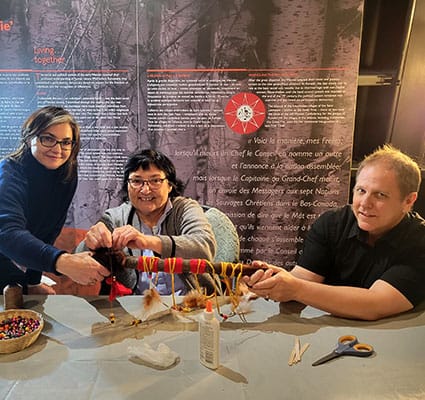
photo of two women and a man making a talking stick
photo of talking stick

I am truly proud of the work our small team has accomplished.

Our vision is that all Indigenous people have the capacity the require and the ability to assess, monitor and manage the cumulative effects occurring on their lands, waters and communities. We are excited for the future as we continue to share knowledge to empower community-based approaches to culturally relevant cumulative effects assessment, monitoring and management to support Indigenous well-being and decision-making.

I would like to say Chi Miigwetch to our Board of Directors, Technical Advisory Committee and partners for their ongoing support, knowledge and guidance.

In good spirit,

Leea Litzgus
ICCE Executive Director

Read More
photo of treena wynes and sean power

Our Team is Growing!

ICCE is very pleased to announce two additions to our team in the positions of Associate Executive Director, and Executive Officer and Entrepreneur-in-Residence.

photo of treena wynes
Treena Wynes
Associate Executive Director

Treena Wynes is a member of the Lac La Ronge Indian Band in Northern Saskatchewan. She comes to ICCE with six years of experience leading Indigenous agencies in Director positions. She most recently held a Director position at the Saskatoon Tribal Council where she built their new child and family services agency from the ground up. 

Treena was also an Executive Director for the Heiltsuk Nation’s child and family services agency in Bella Bella where she lived for two years. She found the experience of living in the Heiltsuk community rewarding as she was able to learn about the rich and vibrant culture of the Nation she served. 

Treena attained her social work degree from the Saskatchewan Indian Federated College (now First Nations University) in 1999. She is a registered social worker and published author. 

Fun fact about Treena is she was in a Dierks Bentley/Deric Ruttan music video which made the CMT’s Top 20 for six weeks.

photo of sean power
Sean Power
Executive Officer, Entrepreneur-In-Residence

Sean Power joins ICCE as Executive Officer and Entrepreneur-in Residence (EIR). Sean brings 20 years of private-sector entrepreneurship experience. 

His work has directly contributed to the eventual acquisition of some of the companies he has been involved in, most notably by Dinnerlab (Dishcrawl), BMC (Coradiant), Salesforce (CoTweet) and Google (PostRank). He has fundraising expertise in both the public and private sector and has advised many company and non-profit founders to help them scale. 

Sean has written books on the topic of business metrics (one of which was translated into nine languages and sold around the world) and has spoken about this topic at countless private and public events, including giving lectures at universities such as McGill University and Utrecht University.

Please join us in welcoming Treena and Sean to the ICCE team!

Read More
screen capture of icce knowledge centre interface

ICCE Launches Cumulative Effects Knowledge Centre

ICCE is excited to announce the launch of its Knowledge Centre, which contains information, resources, and best practices related to cumulative effects. ICCE developed this Knowledge Centre, with two main objectives: to bring together documentation available on the subject of cumulative effects and to make it easily available for Indigenous communities to access.

ICCE’s mission is to create networks, develop and share knowledge that empowers community-based approaches to culturally relevant cumulative effects assessment, monitoring, and management, that supports Indigenous well-being and decision-making.

Our Knowledge Centre is an important new tool to help build and enhance the technical and scientific capacity of Indigenous communities. It will help us address cumulative effects, based on the values of First Nations, MÃĐtis, and Inuit communities across Canada.

The Knowledge Centre is available on our website at www.icce-caec.ca

If you have any comments or issues with the Knowledge Centre please contact us.

Read More
photo of indigenous drum and drumstick

Regional Dialogue Sessions Now Open for Registration

The Indigenous Centre for Cumulative Effects (ICCE) is excited to be hosting regional dialogue sessions across Canada as part of its National Needs Assessment to inform its strategic planning, and ultimately the future of the organization.

A key objective of the Needs Assessment is to assess the ongoing need in Indigenous communities for awareness and education around cumulative effects. The needs assessment will also help inform the development of new and effective tools, capacity building, and supports to address cumulative effects.

These sessions will be held across Canada at the following locations:

Session Location Date & Time 
Eastern Session Dartmouth, Nova Scotia September 23, 2022 – 8:00 am
Northwest Session Fort McMurray, Alberta October 4, 2022 – 9:00 am
Arctic Session To Be Confirmed To Be Confirmed
Central Session Ohsweken, Ontario October 13, 2022 – 9:00 am
Virtual Metis Session Virtual via Zoom October 19, 2022 – 9:00 am
Prairie Session To Be Confirmed To Be Confirmed

The capacity for these sessions is limited, so please register as soon as possible by browsing our online calendar.

Compensation for travel and accommodation expenses will be available for one representative per community or organization.

If you have any questions in regards to the regional dialogue sessions please contact us.

Read More
screen capture of icce directory of cumulative effects practitioners and projects

ICCE Develops Directory of Cumulative Effects Practitioners and Projects

ICCE announces the launch of Canada’s first-ever Directory of Cumulative Effects Practitioners and Projects.

The cumulative effects practitioners featured in this new interactive portal represent a range of diverse backgrounds including Indigenous communities and organizations, academia, consultants and government. These practitioners are plotted on an interactive map linked to professional profiles and related projects within the directory.

screen capture of icce directory of cumulative effects practitioners and projects

Users of this online directory can easily search for practitioners and projects using various filters, including:

  • Practitioner
  • Project
  • Organization
  • Address
  • Province/Territory
  • Type of Work
  • Focus

This new directory aims to facilitate nationwide networking via knowledge sharing relevant to cumulative effects engagement, assessment, monitoring, and management. It also includes a compilation of additional resources comprising cumulative effects regulations, reports and issue papers.

The goal is to ensure that connecting with these practitioners is seamless and easy. Users can reach out directly to the various practitioners via the secure contact form on each profile page.

The development of this and other online resources are part of ICCE’s strategic plan to support Indigenous communities in the development of resources, protocols, and frameworks to better address cumulative effects issues in communities and territories across Canada.

If you are a cumulative effects practitioner and are interested in having your profile and projects added to this directory, please contact us. 

Read More